
Stillness Is Strength: Why Quiet Moments Build Inner Power — With Recent Insights

In a culture that equates success with speed, productivity, and constant motion, the idea that stillness could be strength may feel counterintuitive.
For many professionals carrying sustained responsibility, acceleration becomes normal. Urgency becomes baseline. Constant input becomes invisible background noise.
Yet recent research — from mindfulness science to cognitive psychology — continues to confirm something profound: true strength does not grow from continuous stimulation. It stabilizes in moments of intentional pause.
Stillness is not escape.
It is recalibration.

Stillness Isn’t Weakness — It’s Intentional

Stillness is often misunderstood as passive.
In reality, it is a deliberate act of stepping back from noise to restore clarity.
Studies on mindfulness and attentional training consistently show that quiet, focused pauses help regulate emotional response, sharpen cognitive function, and improve stress resilience.
This is not abstract philosophy. It is measurable.
When we interrupt constant input, the nervous system begins to stabilize. And when the nervous system stabilizes, reaction decreases and perspective widens.

The Science Behind Stillness

1.

Reduced Stress, Improved Cognitive Stability
When we slow down — through mindful breathing, reflective pause, or simple silence — cortisol levels decrease. This is not merely “relaxing.” It improves emotional regulation and decision quality.
Research has shown that mindfulness practices influence brain regions associated with attention, memory, and self-awareness. Over time, this supports clearer thinking under pressure.

2.

Emotional Resilience Through Pause
Quiet moments create space to process experience instead of reacting impulsively.
Instead of chasing distraction, stillness allows response to replace reaction.
This widening of internal space is a form of strength — especially in environments where responsibility remains high.

3.

Physical Stillness Supports Mental Clarity
Stillness is not only mental. It is physiological. Intentional rest supports recovery, stabilizes heart rate variability, and reduces the chronic activation that often accompanies modern professional life.
Mental quiet and bodily calm are not separate systems. They influence one another continuously.

🌿 Conclusion: The Quiet Strength Within

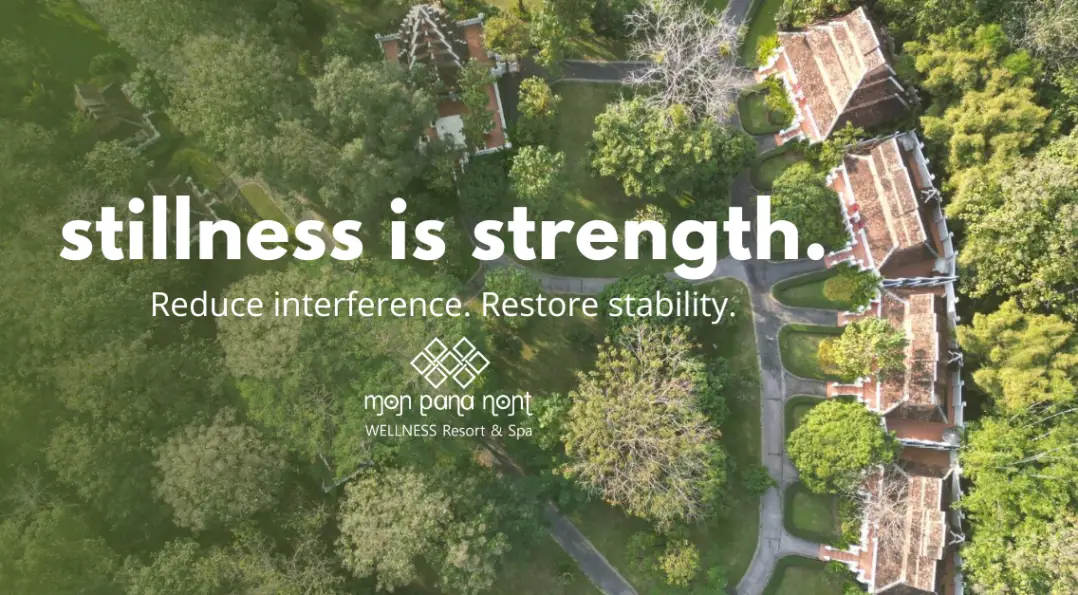
In a culture driven by speed, choosing stillness can feel unfamiliar. But stillness is not about doing nothing. It is about deliberate pacing. When interference decreases, clarity returns gradually — not as inspiration, but as steadiness.
At MonPanaNont, this understanding forms part of our structured recalibration approach.
Not retreat intensity.
Not performance.
Deliberate sequence.
Measured pacing.
Reduced interference.
Because clarity does not grow from acceleration.
It grows from stability.
Share: